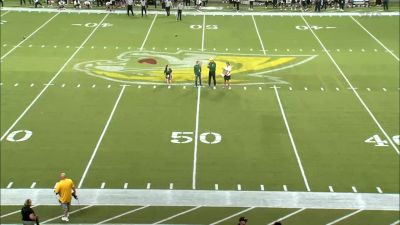
NCAA D2 and D3 College Football at its best features much of the same passion and support that you’ll find at the highest levels of the sport, and watching a critical game at a campus that rallies behind its team is a thrilling experience no matter where you decide to spend your Saturday.
- Subscribe To FloCollege To Watch Division 2 Football In 2025
- Eight Bold Predictions For 2025 D2 Football Season
- Here's the FloCollege schedule this week
Just like NCAA Division I, Divisions II and III feature their own iconic venues that offer some of the best college football viewing experiences available, whether it’s sheer size, uniqueness, or other factors, the names on our list of the top small-college football venues in the country all bring their own stories to share.
Here are our picks for 10 of the best hidden gems when it comes to college football stadiums:
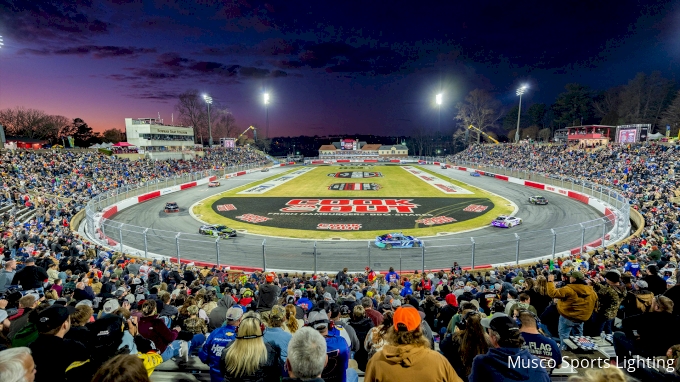
Bowman Gray Stadium (Winston-Salem State)
A massive stadium for the D-II level at 17,000 capacity with a horseshoe layout, Bowman Gray Stadium broke ground in 1937 and has played host to the Rams ever since, but it’s the only venue on this list that’s better known for its history in another sport.
Why? A paved quarter-mile auto racing track was installed around the football field in 1947, and nine years later, a then-fledgling NASCAR competed at the stadium for the first time, doing so until 1971 as it became one of the sport’s most iconic venues of its early days.
Deterioration and decay marred the stadium for much of the next half-century before millions of dollars of renovations arrived over the past decade, culminating in a historic facility with a modern edge for WSSU football — and NASCAR’s official return to the track for an exhibition race in February of this year.
Clemens Stadium (St John’s)
With a nickname like “The Natural Bowl,” Clemens Stadium has more than earned its reputation as being one of the most beautiful small-college football facilities in the country — and one of the most imposing places to play in all of D-III. Constructed in 1908 on a hillside and the remnants of a cranberry marsh, the foliage surrounding the home of the Johnnies has remained largely untouched over generations, creating a picturesque contrast in the Minnesota fall with the red and powder blue of SJU.
Though it officially holds around 7,500 people, Clemens Stadium’s location plays to the Johnnies' advantage for big games as fans can easily pack the hills to double that number or more; the record attendance is a stunning 17,327 for the Johnnie-Tommie Game against now-FCS St. Thomas in 2015.
John Gagliardi, the winningest coach in college football history, also helped to make Clemens Stadium a fortress across his legendary tenure from 1953-2012, leading SJU to four national championships (two NAIA, two D-III) along the way.
Superior Dome (Northern Michigan)
Domes are beloved by college football fans, but NMU’s Superior Dome likely takes the cake for being the most unique indoor stadium in the sport. Towering 14 stories high and taking up over fåive acres of space on the banks of Lake Superior, the Superior Dome stands tall as the largest wooden dome in the world, built in 1991 as the home of the Wildcats’ football, women’s lacrosse, and women’s track and field teams.
Featuring a permanent capacity of 8,000 with an ability to expand well beyond that — like when 11,000 packed it for a men’s basketball exhibition between NMU and Michigan State last season — the dome’s field is a retractable artificial turf carpet that is the largest of its kind in the world, while it is additionally home to the U.S. Olympic Education Center, the country’s second-largest Olympic training center by resident count.
Stadium of the Morning🥞
— CFB Home (@CFBHome) August 7, 2025
🏟️: Superior Dome
📍: Marquette, Michigan
✅: Capacity 8,000
Home of @NMU_Football pic.twitter.com/gCyicST8tb
Perkins Stadium (Wisconsin-Whitewater)
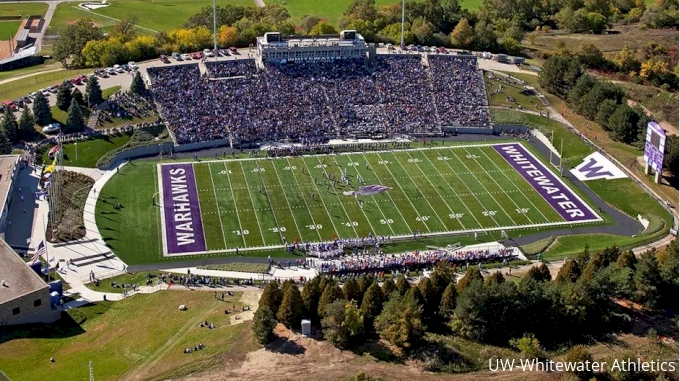
Need evidence for how serious D-III football is in Wisconsin? Look no further than Perkins Stadium, which at a monstrous capacity of 13,500 people not only stands tall as the largest venue in D-III, but can also pack in more fans than two current D-I FBS stadiums (Kennesaw State and Northwestern) and dozens of FCS stadiums.
UW-Whitewater has been serving up one of the premier viewing experiences in D-III football since 1970, when what was then-called Warhawk Stadium was built at a still-huge capacity of 11,000 people. Touch-ups and improvements eventually led to the current capacity, a turf field, and a massive videoboard, and Warhawk fans have been treated over the years to their school becoming a D-III blue-blood with it as the program won six national championships from 2007-14.
The towering wall of seating on the home side, especially when packed to the brim during a high-stakes Warhawks game, creates a viewing experience unlike any in D-III.
Butterfield Stadium (Ithaca)
Simultaneously scenic and strange but always a great place to watch a D-III college football game, the home of the Bombers for nearly 70 years (and in its current form since 1976) has unique, towering walls on each sideline where the grandstands are placed above, giving the venue an old-school feel mixed in with the natural beauty of upstate New York.
Cayuga Lake and the surrounding environmental landscape are easily visible from the home stands, where you and around 5,000 other football fans at official capacity — though Butterfield Stadium has packed crowds of over 10,000 spectators before — get to check out the Bombers on fall Saturdays with a view.
The Cortaca Jug Game against hated adversary SUNY Cortland, one of D-III football’s most historic rivalry games, is always a can’t-miss matchup at Butterfield, with no bad seats in the house — if you can find a seat, that is.
Moretz Stadium (Lenoir-Rhyne)
The home of the Bears for over 100 years, Moretz Stadium shines as a classic, vintage jewel of southern college football in an era where newer college football stadiums often lean on extravagance.
Able to hold 7,200 fans with an opportunity to expand to up to 10,000 in the future following extensive renovations over the past few years, brick walls line three sides of Moretz Stadium with plenty of room for passionate Bears supporters on top of them to cheer on games that take place “between the bricks.”
An electric environment for D-II football for decades, Lenoir-Rhyne made the gameday experience at Moretz Stadium even better when it launched an $18 million renovation project in 2022, resulting in an entire rebuild of the press box and home-side bleachers, a new entrance and a second videoboard to go along with the giant one in the open end zone — the third-largest in D-II football.
🏟️ Moretz Stadium Visit 🏟️
— College Football Campus Tour (@cfbcampustour) September 19, 2024
📍 Hickory, North Carolina
🏠 Lenoir-Rhyne @LRBearsFootball
🕰️ Opened in 1924
🪑 7,200 seats
🗓️ Next home game: 9/28 vs Tusculum#GOBEARS 🐻🧱🐻 pic.twitter.com/Us4nC1tzcv
Alumni Field at Marv Kay Stadium (Colorado School of Mines)
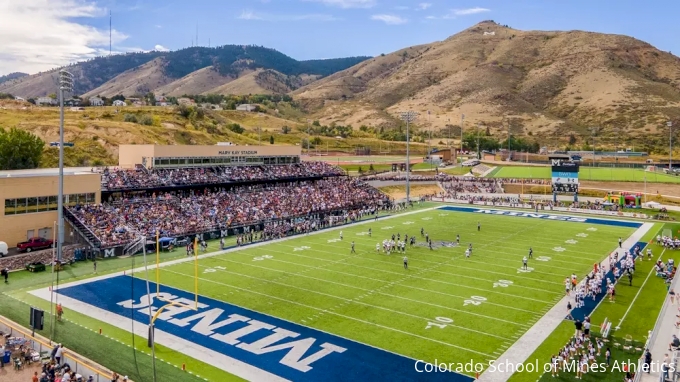
History, scenery, and hard-nosed football in the Rocky Mountains define the experience of visiting Alumni Field at Marv Kay Stadium for a Mines game, which is the oldest site still in use in both D-II football and west of the Mississippi River at any level.
The Orediggers have been playing since 1893 at what was first known as Athletic Park, surrounded by the towering mountain peaks that loom over the city of Golden, Colorado, located just west of Denver. The facility has seen a few major makeovers over the years, most recently when it earned its current name after being entirely rebuilt in 2014-15 and when sleek additions to the West End Zone that helped increase the stadium’s capacity to over 4,000 people, and there’s also the bonus of Mines football being currently in a golden age; the Orediggers made every D-II playoff bracket from 2018-23, even winning a national semifinal game at their home stadium in 2022.
Hollingsworth Field (Gustavus Adolphus)
Gustavus Adolphus’ home facility is small, seating 2,500 fans with an overflow capacity of around 5,000, but it’s a gem of D-III football in the small college football-crazy upper Midwest.
Built at a $4.6 million price tag in 2007, the Golden Gusties have played football games there ever since on a turf field that sits below ground level, which plays with angles and positioning to give Hollingsworth Field — a name retained from the now-demolished old stadium that the Gusties played at for a century — a bowl-like feel that’s a rarity at the D-III level.
Bleacher seating (along with a stadium seating section on the home side) is located on both sides of the facility, but for an authentic Gusties viewing experience, pop a squat on the grass berm viewing area that lines around the stadium and enjoy the show on a beautiful Minnesota fall Saturday.
Bain-Schaeffer Buffalo Stadium (West Texas A&M)
Texas takes its college football seriously, and you’d be hard-pressed to find a better venue in the Lone Star State beyond the D-II level than the current home of West Texas A&M. Opened in 2019, the enclosed Bain-Schaeffer Buffalo Stadium can hold 8,500 fans along the west and east-side bleachers — which include seven suites with premier views and a common gathering space — with an overflow capacity of 12,000 when including the berm seating along each endzone and the standing room-only spaces at the concourse level.
The venue is state-of-the-art, being one of the few D-II football stadiums to have either double-decker seating or a ribbon scoreboard (which is placed along the front of both upper decks). At the same time, the videoboard at the north endzone is massive and imposing, giving the Buffaloes a field that would rival many at the FCS level in terms of quality.
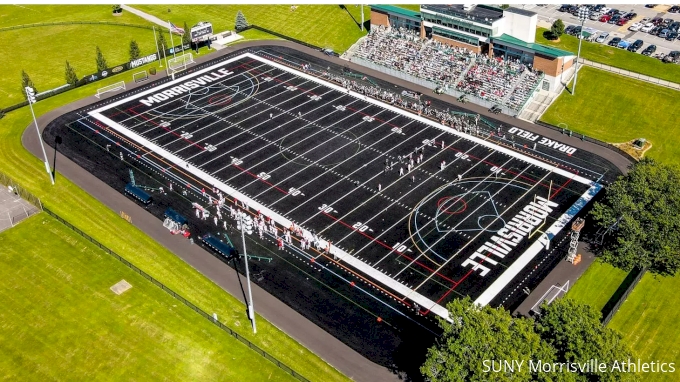
Drake Field (SUNY Morrisville)
SUNY Morrisville’s home likely wouldn’t have sniffed this list before 2023, but the athletic department made a major switch that summer that made it an instantly iconic college football venue.
Drake Field was a nice-enough multi-million-dollar stadium before then for the D-III level, featuring bleachers on one side with a concourse and a solid press box. But when the stadium was due for a field turf replacement ahead of the 2023 season, SUNY Morrisville went the colored-turf route — but turned heads when black was the color of choice.
The only college football program in the country at any level to play on black turf, the Mustangs’ facility is now one-of-a-kind in college athletics and features marking colors for the school’s other outdoor sports (powder blue for women’s lacrosse, lime green for soccer, etc) that you likely won’t find anywhere else.
And as for the (literal) burning question of whether a black turf would be too hot to play on in high temperatures, athletic director Matt Grawrock told local media that studies showed a black turf isn’t significantly hotter than a green turf.
How To Watch D2 Football In 2025
Hundreds of Division 2 football games will stream live on FloCollege and the FloSports app.
Game replays, highlights and breaking news will also be available on both platforms.
Archived Footage On FloCollege
Video footage from all games will be archived and stored in a video library for FloCollege subscribers to watch for the duration of their subscriptions.
Watch The 2025 College Football Season On FloCollege
FloCollege is the home of the best FCS, Division II and Division III football action all season long.
Don't miss the latest college football action by bookmarking the FloCollege schedule page for the latest games.
Join The College Football Conversation
- Follow us on Twitter @FloCollegeFB
- Follow us on Instagram @FloCollegeFootball
- Follow us on TikTok @FloCollegeFootball
- Watch us on YouTube
- Like us on Facebook